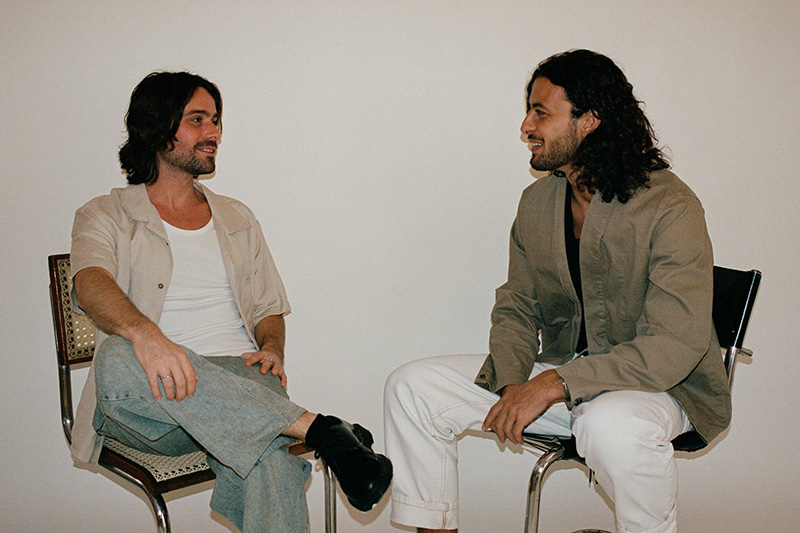
Mozambo revisit Angie Stone’s “Wish I Didn’t Miss You” with a version shaped for contemporary club settings, keeping the emotional weight of the original intact while reframing it through their own production language. What began as a personal edit, sparked by a shared moment of rediscovery in Ibiza, has developed into a considered rework that balances restraint with functionality.
In this conversation, the duo reflect on the responsibility of reinterpreting a record so closely tied to dance music memory, from the influence of Carl Cox’s Space Ibiza closing set to the quieter decisions around arrangement and space. They also touch on collaboration, instinct in the studio, and how their Jungle Disco imprint continues to shape their direction.
“Wish I Didn’t Miss You” carries a lot of emotional history for listeners. When you approached the record, what aspects of Angie Stone’s original performance felt completely untouchable, and where did you see space to reinterpret it within a club environment?
It’s a record we’ve loved for a long time and we’ve always had a strong emotional connection to it. The idea came to us about two or three years ago when we were in Ibiza during the summer. We heard the track again and immediately felt that it deserved a new version that could live again on dancefloors. There was also a bit of nostalgia involved. Like many DJs from our generation, we’ve seen the footage of the legendary closing of Space Ibiza where Carl Cox played his own version of the track. Those moments are part of dance music culture and they definitely inspired us. Our intention was simple. We wanted to create a version we could play in our sets. We didn’t want to just play the original, we wanted our own interpretation. The vocal was the starting point because Angie Stone’s voice and lyrics carry such a powerful emotional weight. From there we slowly built the track around that feeling until we reached the final version.
You’ve described rediscovering the track while digging in Ibiza. What was it about hearing it again in that context that triggered the idea to rework it? Was it a DJ perspective, imagining how it might translate over a system, or something more personal tied to the memory of the record itself?
The story behind this version of the Angie Stone track is actually quite funny. At the time I, Alexis, was in Ibiza and Guillaume was arriving a couple of days later. I remember being by the pool listening to music and suddenly thinking that we absolutely needed to make a version of “I Wish I Didn’t Miss You.” A few hours later, or maybe the next day, we spoke on the phone and Guillaume told me he had already started working on a version of the same track. We couldn’t believe it. We had exactly the same idea at the same moment without even talking about it. It was a strange but funny coincidence, almost like telepathy. At the beginning it was something very personal. We simply wanted a version we could play in our DJ sets because we love the original so much. Later, after testing it in clubs and seeing the reaction from people, we started thinking about releasing it officially. But at first it was really just for us and for the pleasure of playing it in Ibiza.
There’s a fine balance in the remix between rhythmic movement and leaving the vocal room to breathe. From a production perspective, how did you build the arrangement so the percussion and bass support the vocal rather than compete with it?
We wanted the track to feel quite stripped back so it would keep the soul of the original. Angie Stone’s voice carries such a powerful emotion that for us it had to remain the central element of the record. Our idea was to build a new rhythmic foundation around it that would work in a club environment while still leaving enough space for the vocal to breathe. We also added a more orchestral feeling toward the end of the track to bring another emotional layer. It was really a question of balance. We tested different arrangements until everything felt right. In the end we tried to keep the production as clean as possible and focus on supporting the voice rather than competing with it. Remixing a record like this is a big responsibility, so our goal was to honour the original while bringing our own vision to it.
Antdot’s involvement adds another dimension to the record. When you collaborate with another producer who already has a defined sonic identity, how do you navigate that exchange in the studio so the result still feels cohesive?
The story behind the collaboration with Antdot on this track is actually quite funny. We had already been in touch with him on Instagram for a while, sharing music and supporting each other’s tracks. Then one day we saw that he was playing in Marseille, our hometown, for a Cercle event. We happened to be there at the same time so we reached out to him. It was actually his first time in France. He came to our place and we spent some time listening to music together and sharing ideas in a very natural way. At some point we played him our version of “I Wish I Didn’t Miss You” and he immediately loved it. He suggested that we finish it together. From there the collaboration happened very naturally. We worked on the track together and exchanged ideas until we reached the final version. The whole process was very organic and built around friendship and musical sharing. It’s a record that means a lot to us.
Angie Stone’s music sits at an interesting crossroads between gospel tradition, classic soul songwriting and early-2000s R&B production. When translating that into a contemporary club setting, which of those elements did you find yourselves responding to most strongly?
On this track you can probably hear many of our influences coming together. We have always been big fans of soul, disco and house music. After years of listening, DJing and producing, some things become almost instinctive and happen without overthinking. Gospel is also a huge influence for us because of the emotional and spiritual energy it carries. At the same time we are very inspired by early 2000s house music and by disco records that have that timeless groove. In the end it is really a mix of all those influences. Our goal was simply to bring as much emotion as possible into the track while adding our own interpretation and our current sound.
You mentioned the Carl Cox moment at the closing of Space Ibiza as a reference point. That era of Ibiza carried a particular emotional weight for many people in dance culture. Do you think part of the appeal of revisiting records like this today comes from a broader sense of nostalgia within the scene?
Yes, clearly there is a sense of nostalgia behind it. We grew up hearing stories about Ibiza in the early 2000s, about the spirit of the island and the culture of the dancefloor. Watching old footage and listening to older friends talk about that era definitely created a fascination for us. It is the same with other legendary moments in dance music history like the explosion of disco in New York, places such as Studio 54 or Paradise Garage. Those moments represent something very pure about music and community. For younger generations who didn’t experience those times, there is naturally a bit of nostalgia and imagination around it. For us it is mainly a source of inspiration. We try to take the best parts of that energy and adapt them to what we want to create today.
Your recent releases suggest a clearer definition of the Mozambo sound. Looking back over the last couple of years, what changes in your studio process or listening habits have helped shape that direction?
There has definitely been a change over the past few years but it happened very naturally. As we kept producing, traveling, playing shows and listening to more music, we gradually gained maturity and a clearer artistic vision. Many things simply come with time. It takes years to develop the right instincts in the studio and to fully understand what you want to express as an artist. There were ideas and directions we always wanted to explore that we are only now able to express properly. It is really a combination of experience and creative confidence. When we look back at our journey we feel very proud and very happy with the direction the project is taking.
With Jungle Disco continuing to grow alongside your artist project, how do you see the relationship between the label and your own productions evolving? Does running the imprint influence the music you make, or does it mainly act as a platform to connect with artists working in a similar space?
For us, Jungle Disco is a natural extension of the Mozambo project. It is our musical laboratory where we can experiment and release music freely without thinking about whether it fits the expectations of a label’s A&R. We can release what we want when we want and we really enjoy that freedom. It allows us to follow our instinct and explore ideas without limitations. In the long term we would also love to welcome other artists and expand the universe around the label. Jungle Disco is really an extension of Mozambo and a place where we can express our vision freely and build our world around music.