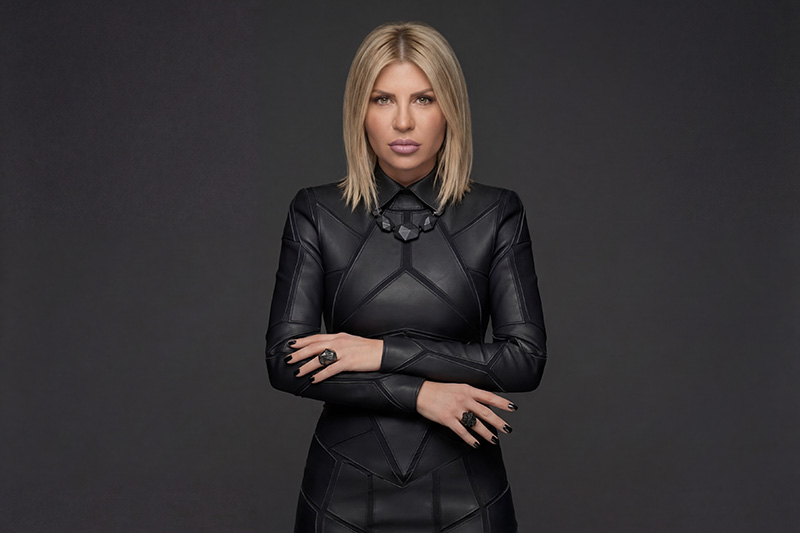
Amymi Musica is an artist who has never belonged to one sound. Moving across techno, trance, melodic, and psytrance, she has built a career defined by curiosity over category — and recently launched UnGenre Records, a label built on that same philosophy. Her debut label release, Distorted Thoughts made its mark immediately, reaching #39 on the Beatport Top 100, #13 on the Hype chart, and #11 on the Top 100 Release chart.
Amymi You started performing as a kid, singing live and even hosting your own radio show. At what point did electronic music start to feel less like “another instrument to explore” and more like the natural direction for you?
Since childhood, music has always been a natural part of me — I was performing, singing live at school and small local theatres, even hosting my own radio show. I was always drawn to sharing energy with others and creating moments through sound. In the beginning, I was more connected to pop music, jazz and rock, but that shifted completely in my early adulthood.
At the end of the ’90s, when I started traveling across Europe and beyond — especially to cities like Paris, Berlin, Amsterdam, and New York — I discovered the underground electronic scene. That’s when everything changed. I fell deeply in love with the raw power of drums and bass, and the way the crowd became fully immersed in the music. It wasn’t just about listening anymore; it was about experiencing something collective and almost transcendent.
There was something very pure about that time. No social media, no digital shortcuts — you had to be physically present to discover new sounds, to connect with artists, and to be part of that world. I found myself naturally engaging with strangers, exchanging music, ideas, and energy. It felt real, human, and deeply inspiring.
That’s when electronic music stopped feeling like just another direction to explore — it became home. I felt a strong sense of belonging, both emotionally and creatively. From that point on, it wasn’t a choice anymore; it was a natural direction, and exciting to continue this path seriously.
You’ve moved between techno, trance, melodic, and psytrance without ever fully settling in one lane. Was that instinct always part of your creative identity, or did it come from resisting how quickly the industry tends to label artists?
Yes, that’s very true — I have moved across techno, trance, melodic, and psytrance, and it definitely required a lot of dedication. I took the time to really study each genre separately — the sound design, the arrangement, the emotional language behind it. But looking back, I think this approach comes very naturally from my background.
Before music, I worked in interior architecture and project management, and that deeply shaped the way I create. With every project, I would take the time to understand the concept, build a moodboard, develop a vision, and fully immerse myself in it before moving on to something completely different. I realised later that I’ve been treating music in the same way — each genre became like a new space to design, explore, and emotionally develop.
Every time I dove into a new style, I genuinely fell in love with it. I am very curious by nature, and that curiosity kept pushing me to explore further rather than settle. Over time, I started taking elements from each genre — what resonated most with me emotionally and artistically — and blending them into something that feels true to who I am. That’s how my sound evolved into a fusion of sub-genres, rather than fitting into one defined lane.
It was never really about resisting labels — I simply wasn’t thinking in those terms. I was enjoying the process, first as a DJ and then more deeply as a producer. When I started attending events like the Amsterdam Dance Event in 2018, I became even more immersed — not just in the music, but in learning. I was drawn to masterclasses, workshops, and exploring new gear just as much as the nightlife itself. It was intense, almost like a creative obsession — I barely slept during those days, but I couldn’t step away from it.
In the end, this fluidity in my sound wasn’t a strategy — it was a natural evolution of curiosity, passion, and the way I experience creativity by nature.
The 2018 Amsterdam Dance Event masterclasses are often seen as a turning point. What changed in your approach to production after that experience, and how long did it take before you felt ready to fully commit?
The 2018 Amsterdam Dance Event masterclasses were a real turning point for me, because they shifted my relationship with music from something instinctive into something much more intentional and structured.
Before that, I was already building a foundation — I had spent time learning piano and drums in Dubai, because I believed in understanding rhythm and musicality before stepping into production. But ADE opened up an entirely new world. Being surrounded by artists, masterclasses, and technical insight made me realise how deep electronic music production really is. It wasn’t just about feeling anymore — it was about translating that feeling into sound with precision.
At the time, I was based in Dubai, where access to academies or structured learning in electronic music was limited. I planned to eventually move to Amsterdam and fully immerse myself in that environment, but when COVID-19 hit, everything was put on hold. That period could have slowed things down, but in a way, it strengthened my determination.
The real shift came when I connected with an international artist in Lebanon — Goose Tann — who saw my passion and started mentoring me on playing a live setup with hardware. That gave me direction and pushed me to take things seriously. From there, the commitment became natural — I built my own studio, invested in synthesizers and advanced online courses, and developed a routine of continuous learning. I never stopped since then.
What truly changed after ADE wasn’t just my technical approach to music, but my mindset. I became more disciplined, more patient, and more focused on shaping a sound that reflects my identity rather than just experimenting.
So the commitment didn’t happen overnight — it evolved since childhood. But once it clicked in the right place and environment, there was no hesitation. It became a full immersion into the craft, and that’s something that continues to drive me today and always will.
By 2023, you had built your own studio and gone all in on production. What did it feel like to see a track you made land in the Beatport Top 10 across two different genre charts at the same time?
By 2023, when I had fully committed to building my own studio and going all in on production, seeing my first solo EP reach the Beatport Top 10 across two different genre charts simultaneously was a very unique moment for me.
At first, my reaction was surprisingly calm. I have always been competitive and goal-driven, and I have experienced similar moments of achievement in other fields, so I didn’t immediately process it as something extraordinary. In tennis, for example, I was ranked fifth in the Lebanese Tennis Federation — and at the time, that also felt like a natural result of consistent work rather than something to react to emotionally.
But in music, the perspective changed when I started hearing from other artists and people in the scene explaining how rare and difficult it is to achieve something like that, especially across different genres simultaneously. That external feedback made me pause and really understand the scale of it. Only then did it turn into a moment of gratitude and realisation — and I felt a strong responsibility to keep pushing forward and maintain that momentum.
What made it even more meaningful was not just the chart position itself, but what it represented: a validation of a sound that refuses to stay in one category. It confirmed that the direction I had been exploring — fusing different influences into one identity — can actually resonate on a wider level.
In the end, instead of changing my approach, it reinforced it. It pushed me to go deeper into refining my sound, expanding my vision into a bigger project, and continuing to build music that reflects identity over trends.
Distorted Thoughts is built around a vocal you recorded yourself. How personal was it to place your own voice at the center of the track, and did that feel more vulnerable or empowering in the moment?
Placing my own voice at the center of Distorted Thoughts was one of the most personal decisions in the entire EP. The lyrics are: “It is not a dream, it is not an imagination, it is determination.” That statement reflects exactly what this project stands for — it is the true story of my music career.
The track carries moments from my journey where many doors were closed, but each time I found another one immediately. I started to see these situations not as setbacks, but as challenges that shaped my direction and strengthened my resolve. Some of the most vulnerable moments ended up becoming the ones that pushed me forward the most, and I wanted to translate that energy into sound.
That’s why the vocal sits at the core of the track. It felt important to express this story as directly and humanly as possible. It is not just a conceptual idea — it is a lived experience, and I wanted it to feel that way in the production. I also found it very difficult to find a professional voice that could authentically carry this exact message, and I did not want to rely on an AI-generated voice either. So the most honest solution was to use my own.
In the moment of recording, it felt both vulnerable and empowering. Vulnerable, because you are exposing a very real part of your internal journey. But also empowering, because you are reclaiming those experiences and transforming them into something structured, expressive, and shared.
Ultimately, it became more than a vocal choice. It became a statement of identity — turning personal experience into sound, and turning resilience into something that can be felt through music rather than just described.
The track has been described as turning mental struggle into forward momentum. How directly does your emotional or mental state feed into your production, and do you consciously channel it or does it emerge more instinctively?
Whenever I experience strong emotions or intense situations, I naturally feel the need to go into the studio. It becomes a way to process what I am going through. Sometimes inspiration comes from it, but more than anything, the main drive is simply to feel better and to transform that energy into something constructive. It is very instinctive for me.
With Distorted Thoughts, this connection between emotional state and production was especially present. The track is built around moments of internal tension and reflection, but instead of staying in that space, I wanted to turn it into movement — something that evolves, shifts, and pushes forward rather than remaining static. That idea of transforming mental weight into forward momentum is very aligned with how I naturally create.
I don’t usually sit down and technically plan the emotional direction. It’s less about consciously designing emotion and more about letting it flow through sound design, rhythm, and structure. Once I start working, the emotional state translates itself into decisions — how the drums hit, how textures evolve, how space is used.
At the same time, there is also awareness in the process. Over time, I have learned how to guide that instinct rather than be overwhelmed by it. So it becomes a balance: the emotion initiates the process, but experience helps shape it into something coherent and intentional.
In that sense, production for me is both release and transformation. It starts instinctively, but it often ends up revealing something deeper than what I was consciously trying to express at the beginning — it is a mutation.
You built the track with peak-time club energy in mind, yet its concept feels very introspective. Do you think about that tension in the studio, between what a dance floor needs and what you are personally trying to express?
Yes, I am very aware of that tension, and in a way I see it as one of the most important creative spaces in my work.
When I build a track like Distorted Thoughts, I always think about the energy of the dance floor first — especially peak-time environments where physical impact, drive, and momentum are essential. That structure, that pressure, that forward motion is what gives electronic music its life in a club setting.
But at the same time, I never think about function alone. There is always an internal layer — something reflective, emotional, or conceptual that I am trying to express. In this case, it is about mental states, fragmentation, and turning inner intensity into motion rather than stillness.
I don’t see these two aspects as conflicting. I see them as feeding each other.
The club energy gives the track its body, its rhythm, its drive, its physical presence. The introspective layer gives it meaning and identity. Without one, the other feels incomplete. If it is only emotional, it risks losing direction on the dance floor. If it is only functional, it becomes empty.
In the studio, I also have a very practical test for this balance: if I don’t physically stand up and feel the need to move or dance when the drop comes, then something is missing. That moment is important to me. If I stay seated, I don’t force the track forward — I go back in and start adding or reshaping elements until it reaches that level of physical impact and energy.
So I don’t really choose between introspection and club functionality. I hold both at the same time, and I let the body be the final judge of whether it works.
That balance is what defines my sound.
Looking back at the full arc from childhood performances to founding your own label, what would the version of you from ten years ago find most surprising about where you are now?
Looking back at the full arc — from performing as a child, to discovering underground scenes across cities, to building my own studio and now founding my own label — the version of me from ten years ago would probably be most surprised by how far the vision has evolved beyond what I originally imagined.
When I was a child, I always dreamed of being a famous singer and having my own music videos, which was very on trend at the time. That was the extent of my imagination — very performance-driven, very visible, centred around being on stage and expressing music through voice and movement. I never imagined that I would one day own a record label. That was never part of the dream, because I simply didn’t know that path existed for me yet.
At the time, I also thought owning a record label was something very risky — almost dangerous in a sense. I had seen films and stories that portrayed the music industry as complicated, intense, and difficult to navigate. It felt like something far away from me, not something I would ever step into — yet I was attracted to it at the same time.
Ten years ago, I was still in a phase of exploration driven by curiosity, traveling through different sounds and experiences, and trying to understand where I truly belonged artistically. There was no defined structure or long-term blueprint — just instinct and passion.
What would probably surprise me most is not only the evolution of the dream, but the fact that I ended up building something entirely independent of the traditional path I originally envisioned. Founding UnGenre Records represents that shift clearly. It’s not just about releasing music — it’s about creating a space that reflects my identity and the way I understand music today.
I think the younger version of me would also be surprised by the discipline and structure behind everything now. Back then, it was all about fun, expression, and performance. Today, there is still that emotional core, but it is supported by production, consistency, and a long-term vision.
At the same time, the essence has not changed. The desire to connect, to express, to move people through music — that has always been there since childhood. What has changed is the form it took, and the realisation that my path was not limited to what I originally imagined.
So the biggest surprise is not just what I became, but how the dream expanded into something I didn’t even know was possible at the time.